Milk Crates for Vinyl Records: Do They Fit and What Are the Alternatives?
Usually yes, but milk crates were designed around milk bottles and no two are quite the same. Here is what to measure before you trust one with records.
By Zachary Medeiros, Groove Crate. . 8 min read.
The short answer: yes, records fit in most milk crates, and collectors have used them for decades. The catch is that a milk crate was designed around milk bottles, not around a 12-inch sleeve, and dimensions are not standardised between dairies, regions or manufacturers. Before trusting one, check that the interior measures at least 12.75 inches across and 12.75 inches deep, so a 12.375 inch sleeve clears the walls without room to lean.
Do records actually fit?
A standard 12-inch LP jacket is about 12.375 inches square. That single number decides everything.
For a crate to work you need two things at once, and they pull in opposite directions:
- Enough clearance that sleeves are not forced in. An interior narrower than about 12.5 inches means you are bending jacket corners every time you file a record.
- Little enough clearance that records cannot lean. This is the one people get wrong. An interior much wider than about 13.5 inches leaves a partly filled row free to slump sideways, and a leaning record is under constant sideways stress.
The workable window is roughly 12.75 to 13.5 inches of interior width. For reference, a Groove Crate has a 13.0 inch square interior, which leaves about 0.3 inches of clearance on each side of a sleeve: enough to file comfortably, not enough for a record to fall over.
Interior height and sleeve clearance
Height matters as much as width and gets checked less often. You want the interior at least as deep as the sleeve, so records sit fully inside the walls rather than standing proud of the rim where they catch knocks and collect dust. A 12.375 inch sleeve needs roughly 12.5 inches of interior height as a minimum. Groove Crate has 13.5 inches, so the sleeve tops sit below the rim with room to get fingers in.
Plenty of milk crates are shallower than this, because a milk bottle is shorter than a record sleeve is tall. That is the single most common way a crate fails at this job.
Why milk crate dimensions vary so much
There is no single milk crate. Sizes differ by dairy, by region, by manufacturer and by decade, because the crate was specified around the bottle or carton a particular dairy used. Some are close to a 12-inch sleeve, some are noticeably wider, and some are too shallow to hold a sleeve upright.
This is why you will see collectors disagree about whether milk crates are good for records. They are both right. They are describing different crates.
How to check one before you commit
- Measure the interior, not the exterior. Crate walls can be half an inch thick or more, so the outside dimension tells you little.
- Measure at the base and at the rim. Many crates taper so they can nest when empty, and the base is what constrains the record.
- Run a hand around the inside. Moulding seams, flashing and sharp lattice corners will catch on sleeve edges over time. A few minutes with fine sandpaper fixes the worst of it.
- Put one record in and lean it. If it can fall more than a few degrees off vertical, the crate is too wide to use half full.
How many records fit in a milk crate?
Roughly 65 to 80 LPs for a typical milk crate, against roughly 80 to 100 for a crate with a full 13 inch interior. The number moves with sleeve thickness: single LPs in standard inner sleeves reach the top of the range, while gatefolds, box sets and outer sleeves pull it well below. The arithmetic is worked through in how many records fit in a milk crate.
Whatever the container, do not fill it to its maximum. You should be able to pull a record out with two fingers. If you have to brace the row with one hand and pull with the other, the row is too tight and sleeves scuff every time.
The leaning problem
A record that leans is being slowly bent. In a container noticeably wider than a sleeve, a half full row will slump to one side and stay that way for as long as it sits there.
Two fixes. Keep crates full, because a full crate holds itself upright. Or use a divider, which is a piece of rigid board cut to the interior width. A crate sized to the record avoids the problem because there is nowhere for a record to fall to.
Orientation, stacking and where you put them
Records go in vertically, spine up, the same way books sit on a shelf. Never lay them flat and stack them inside a crate. A flat stack puts the weight of every record onto the ones underneath, and that pressure is what presses warps into a disc over time.
Most milk crates stack, but not all stack squarely, and crates from different sources often do not sit properly on one another. Match your crates, keep the heaviest at the bottom, and treat three high as a sensible limit for a stack you actually want to browse.
The container does not change the environment. Keep records away from radiators, heating vents and the top of an amplifier, out of direct sunlight, and out of attics, garages and damp basements. More in how to store vinyl records properly.
One legal note
In many places dairy milk crates remain the property of the dairy, and taking them from behind a shop is theft rather than recycling. Crates sold as storage crates by retailers are a different thing. Buy from a legitimate seller.
The alternatives, compared honestly
Plastic milk crates
Sturdy, stackable, cheap and close enough to the right size when you find good ones. The long association with record shops and DJ culture is part of the appeal. The trade-off is everything above: dimensions vary, ribbed interiors can catch sleeves, and an open lattice lets in dust. An empty crate also takes up exactly as much room as a full one.
Cardboard record boxes
Inexpensive, light, and often sized correctly for LPs, which is more than most milk crates manage. Fine for a move or short-term storage.
The problem is time under load. Cardboard absorbs moisture and softens, and records are heavy. Handles tear, corners round off, and a box that has sagged lets records lean. They also stack poorly once they start to deform. Reasonable as a stopgap, not a long-term home.
Wooden crates
Generally the best looking option, and rigid enough to take a lot of use. Worth checking two things before you load one: that the interior is actually sized for a 12-inch sleeve rather than built to a rough outside dimension, and that the inside is finished smoothly, because unfinished timber can raise splinters that catch on sleeves.
The practical costs are weight, which is noticeable every time you lift a full crate, and that wood does not fold away when a section is retired. Wood also responds to humidity more than plastic does, which matters more in a damp basement than in a normal room. The full comparison is in plastic vs wooden record crates.
Cube shelving
Widely available, tidy looking, and a cube holds a convenient row. Good for display and for a settled space where the collection has a permanent home.
Shelving is fixed. It does not move with you easily, it cannot be reconfigured, and a partly filled cube lets records lean unless you add dividers. When it is full, the options are a second unit or a cull. Record crates vs shelving covers the choice in detail.
Purpose-built record crates
Sized specifically for 12-inch records, so albums stand square with no wasted margin and nothing to lean into, and identical to one another so a stack sits true. The trade-off is that they cost more than a cardboard box, and one crate is a smaller unit than a whole shelf, so you build the system over time.
Side by side
| Feature | Groove Crate | Generic milk crate | Cardboard box | Wooden crate | Cube shelving |
|---|---|---|---|---|---|
| Interior sized to a 12-inch sleeve | 13.0 in square | Varies | Varies | Varies | Varies |
| Approximate capacity | 80 to 100 | 65 to 80 | Varies | Varies | Varies by cube |
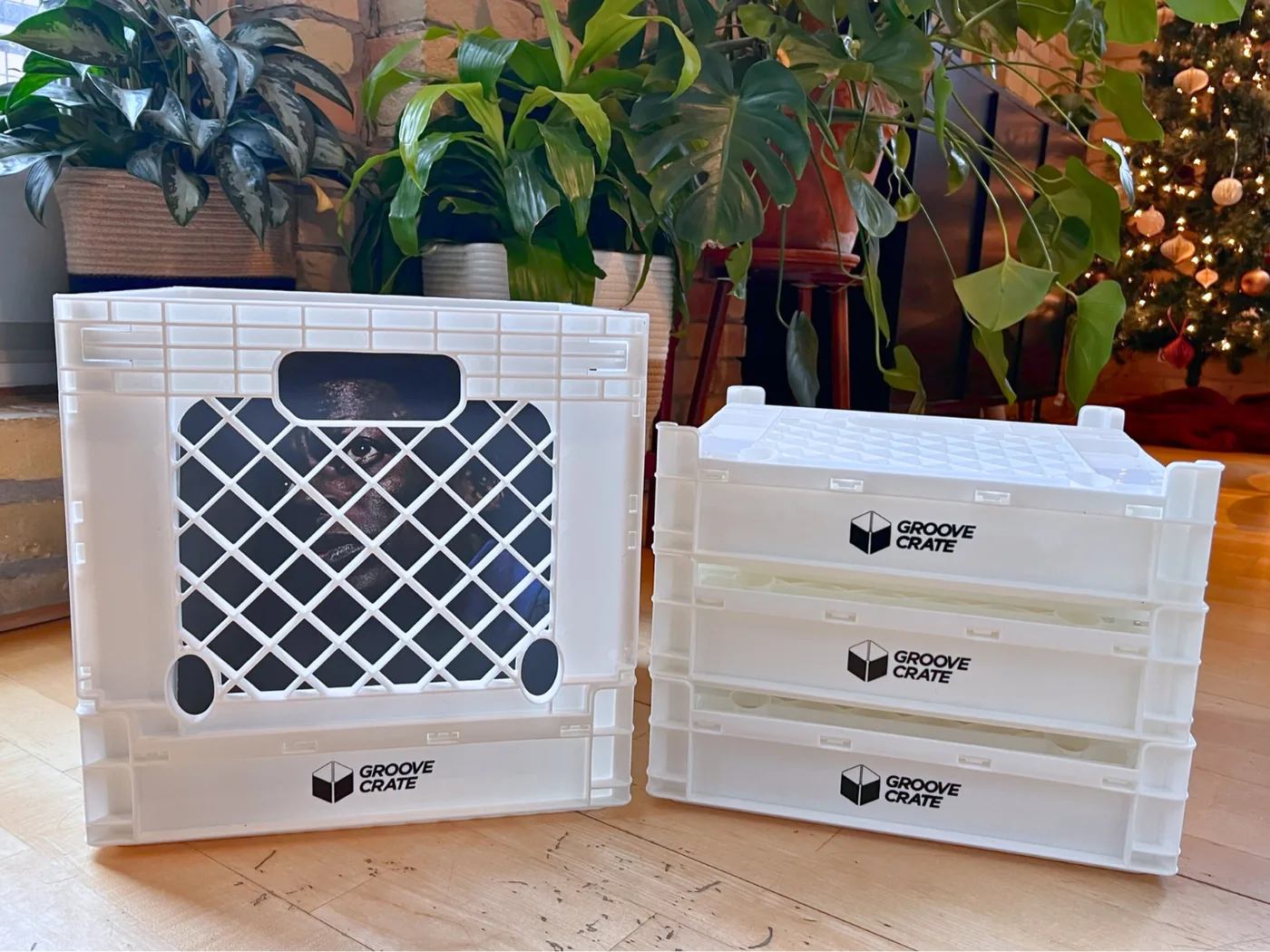
| Folds flat when empty | Yes, to 4 in | Usually no | Yes | No | No |
| Stacks consistently | Yes | Often | Poorly once soft | Yes | Not applicable |
| Easy to move loaded | Yes | Yes | Briefly | Heavy | No |
| Expandable one unit at a time | Yes | Yes | Yes | Yes | Limited |
"Varies" is the honest answer for milk crates, cardboard boxes, wooden crates and shelving rather than a criticism. These are categories, not products, and some examples in each are much closer to the right size than others. Measure the specific one in front of you.
How to choose
Match the container to your situation rather than looking for a single best answer.
- You already have milk crates that fit. Use them. Sand any sharp edges, keep them full or divided, and spend the money on sleeves instead.
- You move often. Crates, ideally ones that collapse. Records travel upright in the crate they already live in, so there is no packing step.
- You have a permanent room and a stable collection. Shelving works well and looks built in.
- You are on a tight budget today. Cardboard boxes are fine as a stopgap, as long as you treat them as temporary.
- You want a known fit and a stack that matches. Purpose-built crates, which is the problem they exist to solve.
Where Groove Crate fits
Groove Crate is the purpose-built option with the milk crate lineage: a 13.0 inch square interior and 13.5 inch interior height, exterior 14.5 by 14.5 by 14.125 inches, holding roughly 80 to 100 records. It stacks because every crate is identical, and it folds flat to 4 inches when a section is retired, which is the one thing a rigid crate cannot do.
If you are weighing it directly against the crates you already own, Groove Crate vs milk crates is the direct comparison, and the full range is here.